


Industry Insights
The Strategic Evolution of Electronic Due Diligence
6 July 2026
·
By Megan Urbach

Listen to this article
4:24
In the legal and financial sectors, certainty is the only currency that matters. Whether you are securing a lien on a high-value asset, verifying a corporate entity for a merger, or conducting Know Your Customer (KYC) checks, the goal has always been the same: to mitigate risk.
However, the method of achieving that certainty is undergoing a radical shift. Over the last few years, we have witnessed the end of due diligence as a mere administrative "checkbox." It has evolved into a strategic imperative driven by a need for speed, precision, and global integration.
Why Modernization is Urgent
For years, due diligence was synonymous with friction. It meant navigating fragmented legacy systems, restricted office hours, and manual data entry. But in today’s economy, friction is a liability.
Three core drivers are forcing this evolution:
- Rising Complexity in Transactions: Legal frameworks are evolving, and cross-border transactions are the norm. Professionals can no longer afford to log into five different systems to check the health of a single multinational partner.
- The Zero-Tolerance Environment for Error: Regulatory compliance requirements are stricter than ever. A "best effort" search is no longer a defense; complete accuracy is the baseline expectation.
- The Need for Speed: In a digital-first world, clients expect real-time results. Waiting 48 hours for a document retrieval process that could be instant via API is rapidly becoming a competitive disadvantage.
The Cost of Legacy: A Real-World Risk
Why does the shift to automated, electronic due diligence matter? Because the cost of human error in manual processes is catastrophic.
Consider the Personal Property Securities Register (PPSR). In a manual workflow, a simple data entry error, a misspelled name or an incorrect serial number can render a registration invalid. We have seen real-world scenarios where a secured lender loses their priority over an asset simply because of a typo. When the debtor defaults, the lender is left with nothing, all because the due diligence process lacked the "Smart Platform Logic" to catch the error before filing.
Modern electronic solutions do more than just speed up the process; they utilize validation logic and AI to ensure that the data being filed is accurate, protecting the firm from liability and the client from financial loss.
The Shift: From Manual Retrieval to AI-Powered Insight
The future of our industry lies in Unified Registry Access. We are moving away from the era of microfiche and localized searches toward a centralized, API-driven ecosystem.
The modern standard for due diligence now includes:
- 24/7 Global Access: The ability to file and search anytime, anywhere, breaking the constraints of government office hours.
- AI-Powered Risk Analysis: It is not enough to just retrieve a document. Advanced platforms now use AI to accelerate review, flagging insolvency indicators, litigation history, and secured liens instantly.
- Workflow Integration: Due diligence is moving out of siloes and directly into the legal workflow, reducing the need for manual re-keying of data.
The Vision: A Global-First Mindset
The most significant change for 2026 and beyond is the collapse of geographical barriers. The challenges our clients face are rarely confined to a single jurisdiction. A "Global Search & File" capability is essential for firms that want to operate efficiently on the international map.
By consolidating disparate legacy platforms into a single, seamless digital workflow, we are not just saving time; we are creating a standardized framework for compliance that travels across borders.
Conclusion
Due diligence is no longer just about finding information; it is about the intelligence to make informed decisions instantly.
For legal professionals and financial institutions, the transition to electronic, automated, and AI-driven due diligence is the only way to ensure certainty in an uncertain world. It is time to stop looking at due diligence as a cost of doing business, and start viewing it as a strategic tool for risk management and client success.

ABOUT THE AUTHOR
Megan Urbach
VP of Product at Dye & Durham
Megan Urbach is a recognized leader in regulatory technology with over 20 years of experience driving the modernization of mission critical registry platforms that improve compliance, efficiency, and user experience across government and private sectors.
Related Posts
Industry Insights
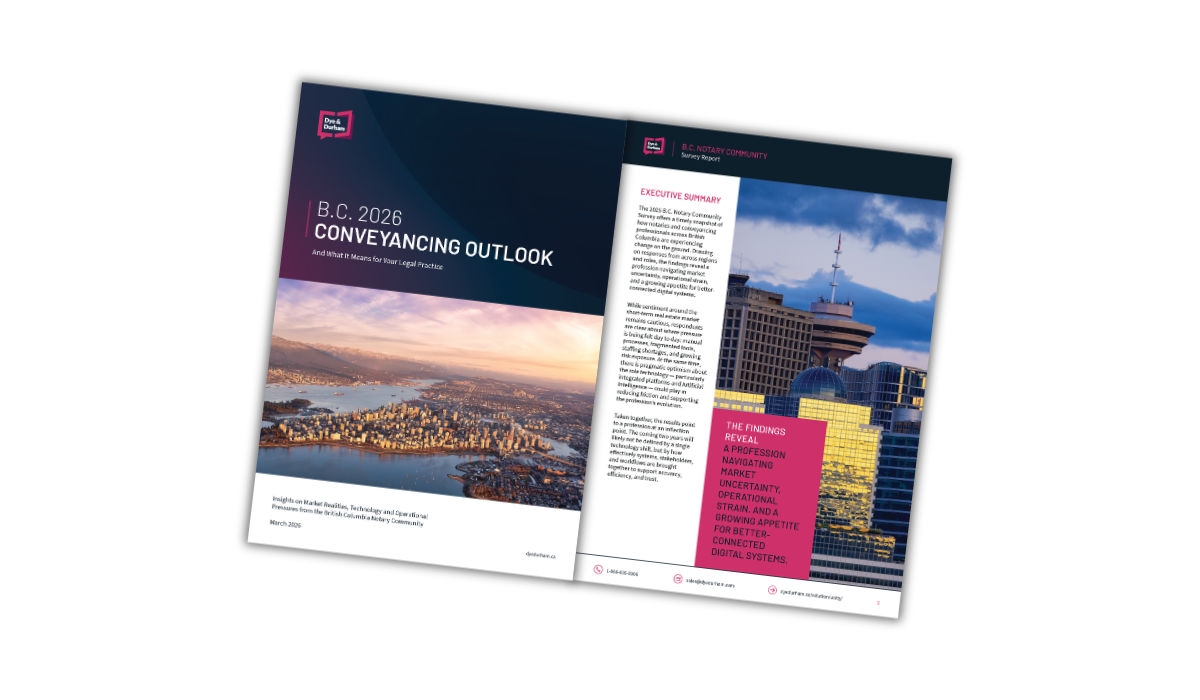
2026 B.C. Conveyancing Outlook (Survey Report)
The 2026 B.C. Conveyancing Outlook gathers frontline perspectives from across the province to help you...
1 July 2026
Read more
Industry Insights
The Strategic Evolution of Electronic Due Diligence
In the legal and financial sectors, certainty is the only currency that matters. Whether you are securing a...
1 July 2026
Read more